
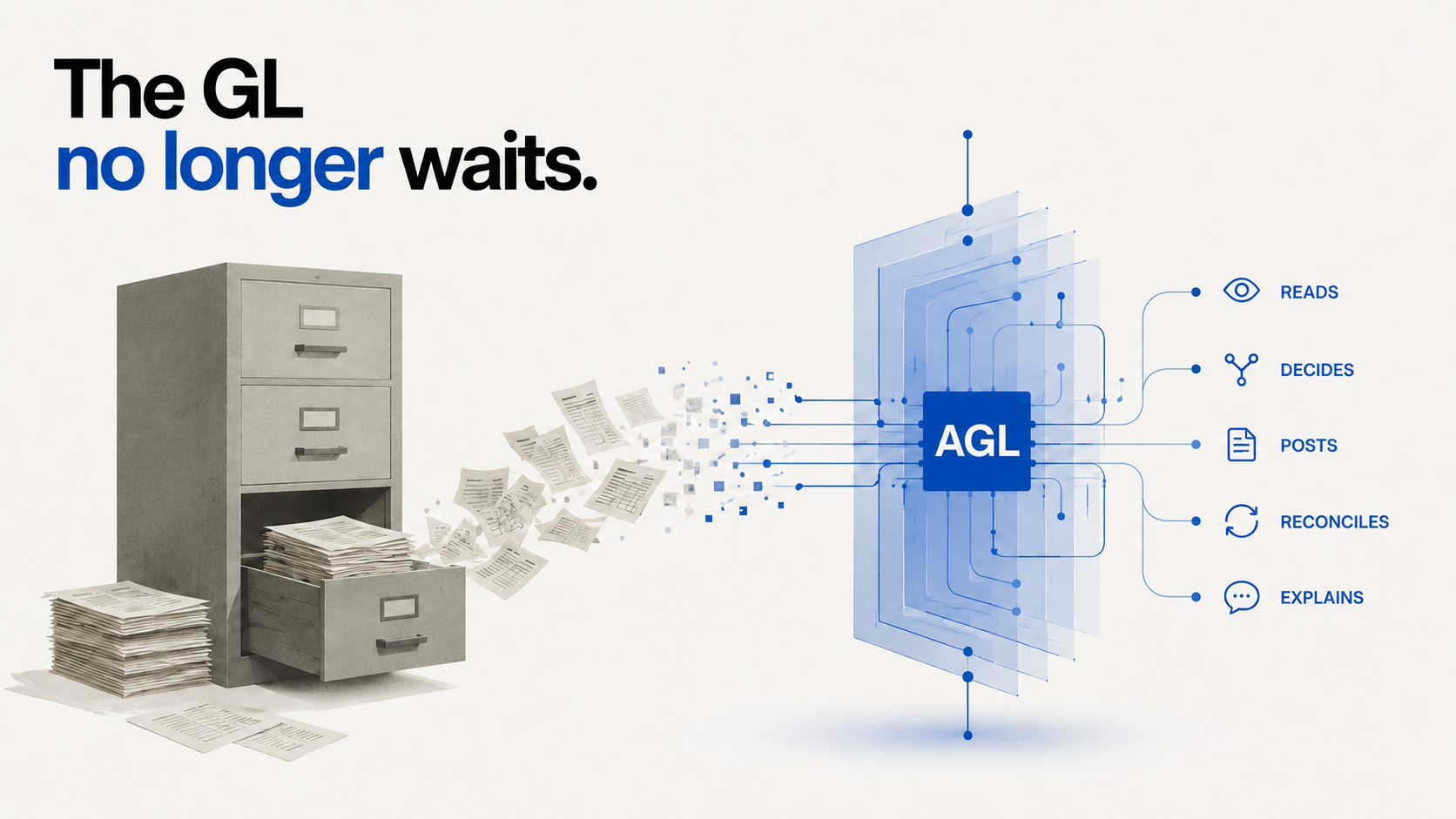
For thirty years, the general ledger has been a filing cabinet with a spell checker.
Every accounting tool since 1995, Exact, Snelstart, QuickBooks, Xero, NetSuite, has been a different skin on the same workflow. Humans read source documents, decide where each transaction belongs, and type it into a chart of accounts. The "automation" wave only ever delivered better forms, better imports, better dashboards. The judgment still sat with a person, and the GL still waited for them to feed it.
The agentic general ledger flips that. The ledger isn't waiting anymore. It reads, decides, posts, reconciles, and explains itself, and asks for a human only when it genuinely can't.
What "agentic" actually means here
It doesn't mean "AI suggestions in a sidebar." It doesn't mean a chatbot bolted onto Exact. It means the ledger has agents that own the work end-to-end:
- Ingest raw events from Shopify, Stripe, Plaid, Mollie, bank feeds, vendor portals, and PDF bills.
- Decide what each event is (a sale, a refund, a fee, a payout, a chargeback, a transfer) using LLMs that read the document, not regex rules.
- Post balanced journal entries the second the event lands, with full provenance back to the source.
- Reconcile bank statements against the GL continuously, not at month-end.
- Explain every entry in plain language, in Dutch or English, so a year's books can be audited in an afternoon.
The chart of accounts is still there. The trial balance is still there. Double-entry is still there. What changed is who is holding the pen.
What it looks like in practice
A seed-stage B2B SaaS startup at ~€500k ARR, billing through Stripe, with EUR and USD bank accounts. Four events land in one hour:
- An annual subscription paid up front through Stripe, in USD on EUR-base books.
- A founder reimbursement on the corporate card.
- An offshore contractor invoice from India.
- A monthly Stripe fee against last month's volume.
Within seconds, no human in the loop: the subscription books as deferred revenue and amortizes monthly with FX locked at payout, the card charge matches a WhatsApp receipt and posts as a liability owed back to the founder, the contractor bill is parsed with reverse-charge VAT applied and staged for approval, the Stripe fee nets against the payout so the clearing account stays flat at zero, and when a customer goes 30 days past due the agent drafts a chase in the founder's tone, sends it, follows up, and reconciles the payment on arrival; at quarter end, the VAT return is built from the live ledger and queued for one-tap filing with the Belastingdienst.
A scaleup with twenty product, tech and sales people with no controller on payroll can operate at 100% close accuracy, because the marginal cost of a transaction is a verifiable AI agent call, not a expensive human hour.
Financial Admin Services as Software
In the SaaS era, software sold tools: QuickBooks for accountants, Clio for lawyers, Greenhouse for recruiters. The AI era flips that. The product isn't a better tool for the professional, it's the work itself. A copilot sells the tool. An autopilot sells the outcome.
For every euro a small business spends on accounting software, several go to the bookkeeper, controller, CFO, and even an audit firm. That spend is mostly intelligence work, already outsourced and well-defined: categorizing transactions, reconciling accounts, filing VAT, chasing receivables. The agentic GL is what lets software absorb it. Every entry carries confidence, reasoning, contract linkage, and intent, so an agent can act on the ledger instead of just reading from it.

What this enables: a finance function you talk to
You don't open accounting software anymore. You talk to it.
Ask. "What's my cash position?" "Can I afford a second hire?" "Prepare my Q1 board pack."
Do. "Invoice ABC for ten hours at fifty euros, send it." "Remind Acme about the overdue payment." "Export the P&L as a PDF."
Watch. "Invoice #INV-2026-035 to Acme is 5 days overdue, send a reminder?" "Cash dropped below €10k, 2.1 months of runway, want to see why?"
The founder replies to a few WhatsApp messages. Everything else (the dashboards, the close, the audit trail, the VAT filings) is downstream.
Would you like to see the platform in action? Book a demo here.