
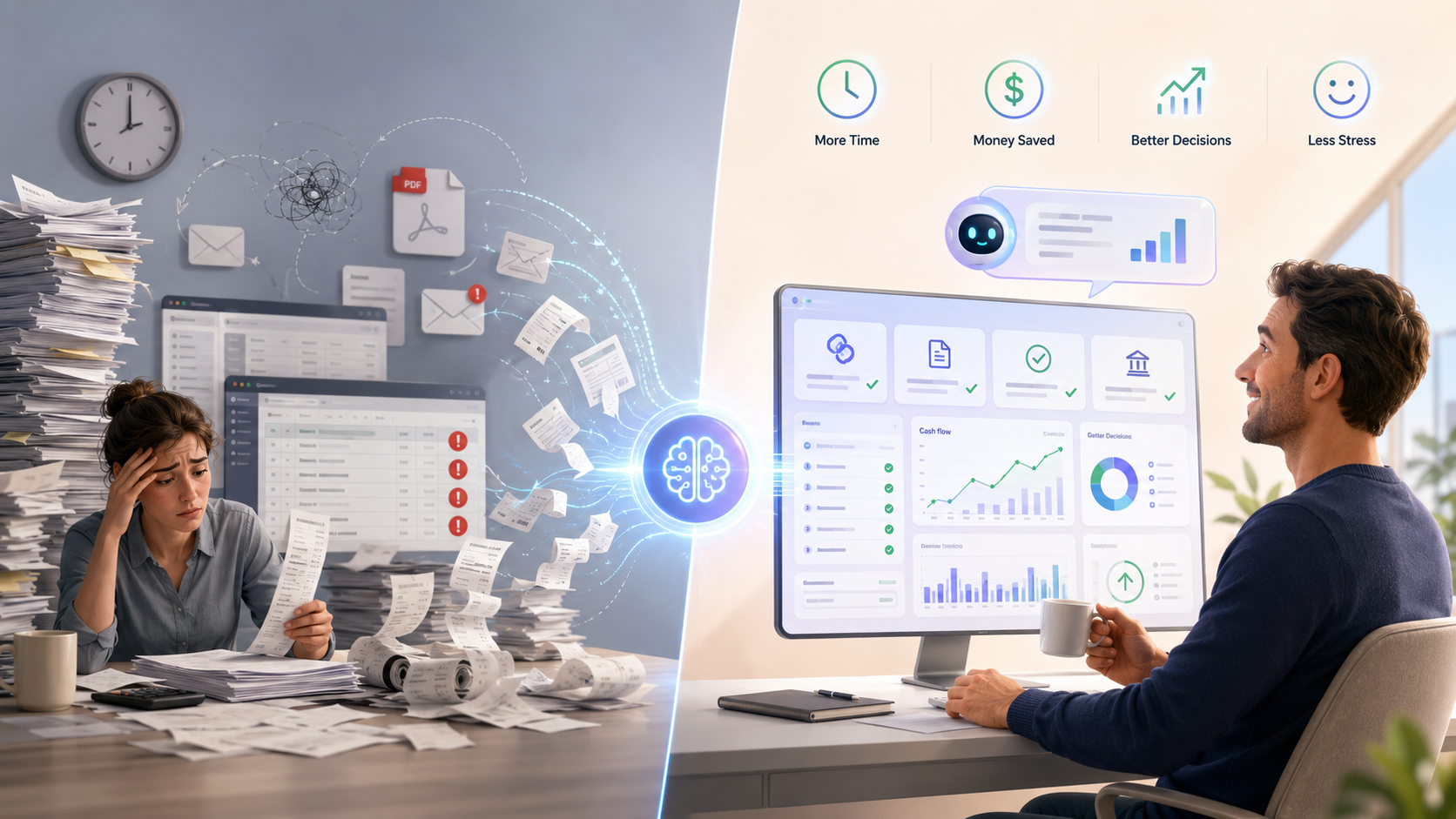
For years, small businesses have been told they need two things to keep their books in order: Accounting software and someone to operate it.
That usually means a tool like Xero, QuickBooks, Sage, Exact, FreeAgent, or another accounting platform, plus a bookkeeper, accountant, admin person, or founder spending time inside the system.
But what if that whole model is outdated?
The real question is not whether accounting software can replace a bookkeeper. It cannot. Traditional accounting software was built for bookkeepers and accountants, not for business owners.
The better question is:
Can an agentic finance platform replace the combination of legacy accounting software and human bookkeeping services?
Increasingly, the answer is yes.
The old bookkeeping stack is the problem
Most small businesses do not really have a bookkeeping problem. They have a stack problem.
The old stack looks like this:
Legacy accounting software + humans operating it + business owners filling in the gaps
The accounting software stores the data. The bookkeeper or accountant operates the software. And when something is missing, unclear, or requires context, the work comes back to the business owner.
That means the founder, freelancer, or small business owner still ends up doing parts of the job they thought they had outsourced.
They still have to find missing receipts.
They still have to explain transactions.
They still have to forward invoices.
They still have to answer questions about payments from months ago.
They still have to wait until month-end, quarter-end, or year-end to discover what is missing.
That is not a modern finance workflow. It is a delayed admin loop.
And it is exactly the kind of loop agentic AI can replace.
Traditional accounting software was built for operators, not owners
Traditional accounting software has helped the industry move away from spreadsheets, paper folders, and shoeboxes full of receipts. It made bank feeds possible. It made digital records easier. It gave bookkeepers and accountants better tools.
But that is the key point:
Traditional accounting software gave bookkeepers and accountants better tools.
It was not designed to remove the need for someone to operate the system.
A human still needs to categorise transactions.
A human still needs to chase missing documents.
A human still needs to check whether a receipt matches a payment.
A human still needs to ask what a supplier invoice relates to.
A human still needs to prepare the books before VAT returns, tax filings, management reports, or year-end accounts.
For a small business owner, this creates a frustrating reality.
Even when you pay for accounting software and pay someone to manage the bookkeeping, you are still pulled back into the process whenever the system lacks context.
So the issue is not that the bookkeeper is doing a bad job. The issue is that the whole setup depends on humans filling gaps that the software cannot understand.
My own experience: The quarterly PDF of unresolved transactions
In one of my previous companies, we worked with an external bookkeeper.
Every quarter, around VAT return time, we would receive an email. Attached to that email was a PDF with hundreds of transactions downloaded from the accounting software.
The bookkeeper had gone through the books and flagged everything they could not process. Sometimes they were missing the invoice, receipt, bill, or another financial document. Other times they simply did not understand the context of the transaction.
So the work came back to us.
As founders, we would spend hours, spread over multiple days, searching through inboxes, folders, supplier portals, payment tools, and old conversations to find the missing information.
What was this card payment?
Who approved this supplier invoice?
Where is the receipt for this subscription?
Was this lunch with a client, a team meal, or something else?
Which company was this payment related to?
Was VAT included?
Had we already uploaded this document somewhere?
None of that work helped us build the business.
It did not help us serve customers.
It did not help us improve the product.
It did not help us grow revenue.
It did not help us hire better people.
It was simply admin debt coming due.
And the worst part was that it happened after the fact. The transactions were already weeks or months old. By the time we were asked about them, the context was often gone.
That is the old bookkeeping stack in a nutshell: delayed, manual, reactive, and dependent on business owners remembering details long after the transaction happened.
Why accounting software plus services still leaves work for the business owner
The old model assumes that bookkeeping is a process that happens after transactions occur.
A payment happens.
A document may or may not be uploaded.
A bookkeeper later reviews the transaction.
If something is unclear, they ask the business owner.
The business owner searches for the missing context.
The bookkeeper updates the accounting software.
The process repeats next month or next quarter.
This model works, but only in the sense that it eventually produces books that can be used for compliance.
It does not work well for the business owner.
It is slow.
It is manual.
It is repetitive.
It is expensive.
It creates interruptions.
It keeps financial data out of date.
It turns the business owner into the memory layer for the finance function.
That last point is important.
In many small businesses, the accounting software does not really know what is happening in the business. The bookkeeper only sees the transaction and the document. The missing context sits in the founder’s head, inbox, calendar, Slack messages, supplier relationships, customer projects, and approval decisions.
When that context is needed weeks or months later, the business owner becomes the system of record.
That should not be necessary anymore.
Agentic AI changes the model
An agentic finance platform is different from traditional accounting software because it does not just sit there waiting for a human to operate it.
It can take action.
It can read documents, understand transactions, match evidence, ask for missing context, learn from previous decisions, and complete workflows automatically.
In practical terms, that means:
A transaction comes in.
The system identifies what it is.
It looks for the matching invoice, receipt, bill, or contract.
It understands the supplier, amount, date, VAT treatment, and business context.
It categorises the transaction.
It flags anything unusual.
It asks for approval when needed.
It learns from the answer.
And next time, it handles the same situation automatically.
That is a fundamentally different model.
It is not accounting software plus a human doing the work.
It is an intelligent system doing the work, with humans involved only where oversight, judgment, or approval is needed.
What exactly gets replaced?
This is where the conversation needs nuance.
An agentic finance platform does not simply “replace a bookkeeper” in the old sense. It replaces the manual bookkeeping workflow that previously required both a bookkeeper and legacy accounting software.
That includes much of the repetitive work small businesses currently pay for or do themselves:
Collecting documents.
Matching receipts, invoices, bills, and transactions.
Categorising expenses.
Checking for missing information.
Reconciling transactions.
Preparing data for VAT returns and other filings.
Flagging exceptions.
Chasing context.
Maintaining up-to-date books.
In my view, with agentic AI, we can automate 99% of bookkeeping work.
That does not mean humans disappear entirely. At least not today.
It means humans stop being used as the operating system for finance admin.
The human role shifts to oversight, judgment, and approval
The best finance systems should not be black boxes.
This is especially true for small businesses, where trust matters. Business owners want automation, but they also want confidence. They want fewer interruptions, but not zero visibility. They want the system to take work off their plate, but they still want control when something important happens.
That is why the right model today is human-in-the-loop.
Humans are still needed for spot checks.
Humans are still needed for judgment calls.
Humans are still needed for approvals.
Humans are still needed to make sure the system is working as intended.
But that is very different from asking humans to manually process hundreds or thousands of transactions.
Over time, even many edge cases can be automated. Once the system has handled a particular type of edge case, it can recognise it again. It has the context, history, and decision trail needed to solve similar cases automatically in the future.
So the human role moves away from manual data entry and admin chasing, and toward oversight, control, and decision-making.
That is a better use of human time.
The real benefit is not just lower bookkeeping costs
Saving money matters. For freelancers, startups, and small businesses, bookkeeping services and finance admin can be a meaningful cost.
But the bigger cost is often hidden.
It is the founder spending hours searching for documents.
It is the freelancer losing an evening to admin.
It is the business owner being interrupted during the workday to explain an old transaction.
It is the finance controller manually cleaning up information that should have been captured automatically.
It is the delay in knowing how the business is actually performing.
This is why the question should not only be, “Can I reduce bookkeeping costs?”
The better question is:
What would you do with all the time and money you save?
Spend more time with your family?
Take a proper holiday?
Focus on customers?
Build your product?
Hire your next team member?
Climb a mountain?
Finally stop spending evenings and weekends catching up on admin?
For many business owners, bookkeeping is not just an expense. It is a mental burden.
Removing that burden is valuable.
Real-time books make finance useful, not just compliant
There is another benefit that may be even more important than saving time and money.
When bookkeeping is manual, books are usually updated after the fact. Once a month. Once a quarter. Sometimes once a year.
That might be enough for compliance. But it is not enough to run a business well.
If your financial data is always late, you are always looking in the rear-view mirror.
You cannot easily answer questions like:
How much cash do we really have available?
Which customers are most profitable?
Are costs increasing faster than revenue?
Which suppliers are becoming more expensive?
Are there subscriptions we are still paying for but no longer using?
Are there invoices we should have sent but did not?
Can we afford to hire?
Can we afford this investment?
What needs attention this week?
Most business owners do not enjoy finance and accounting. They do not want to log into accounting software, run reports, and interpret a chart of accounts. They do not want to wait until the end of the quarter to understand what happened.
But they do want answers.
With an agentic accounting and finance platform, business owners can engage with their financial data in natural language.
They can ask:
“Why was our cash balance lower this month?”
“Which customers still owe us money?”
“What changed in our software costs?”
“Are there any unusual transactions I should look at?”
“How are we tracking compared with last quarter?”
“What should I pay attention to this week?”
Even better, the system can proactively prompt them when something needs attention.
That turns finance from a compliance chore into a decision-making tool.
The future is not more software plus more services
For decades, the small business finance stack has been designed around accountants and bookkeepers.
Business owners had to fit into that workflow. They had to upload documents, answer questions, approve reports, and wait for someone else to make sense of the numbers.
That is changing.
The next generation of accounting and finance platforms will be built around the business owner.
They will not expect founders to become amateur bookkeepers.
They will not require business owners to understand accounting workflows.
They will not wait until quarter-end to ask what a transaction was.
They will not treat finance as a historical record that only matters for tax.
Instead, they will keep the books up to date automatically, in real time, and make financial data useful for running the business.
That is the shift we are building toward at Thred.
We believe small business owners should not have to choose between doing bookkeeping themselves, hiring someone to operate traditional accounting software, or accepting that their books will always be out of date.
There is now a better way.
So, can an agentic finance platform replace your bookkeeper and accounting software?
Yes — if what you mean is replacing the old stack of legacy accounting software plus manual bookkeeping services.
Traditional accounting software cannot do that on its own. It was built to be operated by humans. It helps manage the work, but it does not remove the work.
An agentic finance platform can.
It can reduce the need for internal admin time.
It can reduce reliance on outsourced manual bookkeeping.
It can keep books up to date continuously.
It can learn from context and past decisions.
It can involve humans only where they add real value.
It can turn financial data into something business owners can actually use.
So the future is not business owners doing more bookkeeping.
The future is business owners spending less time on bookkeeping, while getting better financial insight than ever before.
That is the real promise.
Not just lower costs.
Not just fewer emails from a bookkeeper.
Not just fewer missing receipts at VAT time.
The real promise is getting your time back, saving money, and finally having finance work for you instead of the other way around.
Want to see what that looks like? Book a demo with Thred here.